
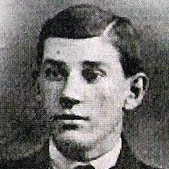
Harold Percival
Diedrich
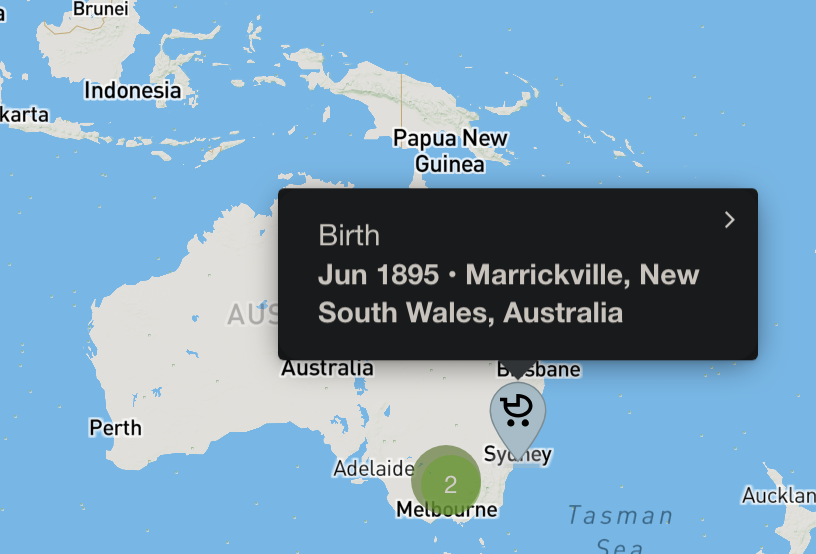
BIRTH JUN 1895 • Marrickville, New South Wales, Australia
DEATH 25 APR 1915 • Gallipolli
Landing Page | Submit Your Ancestors | DIEDRICH
DASHBOARD
Your content goes here. Edit or remove this text inline or in the module Content settings. You can also style every aspect of this content in the module Design settings and even apply custom CSS to this text in the module Advanced settings.
BIRTH
JUN 1895 • Marrickville, New South Wales, Australia
DEATH
25 APR 1915 • Gallipolli
Place of Death
Gallipoli, Dardanelles, Turkey
Service number 555
Rank Private
Unit 6th Australian Infantry Battalion
Service Australian Imperial Force
Conflict/Operation First World War, 1914-1918
Conflict Eligibility Date First World War, 1914-1921
Cause of Death Killed in action
Place of Association North Carlton, Melbourne, Victoria, Australia
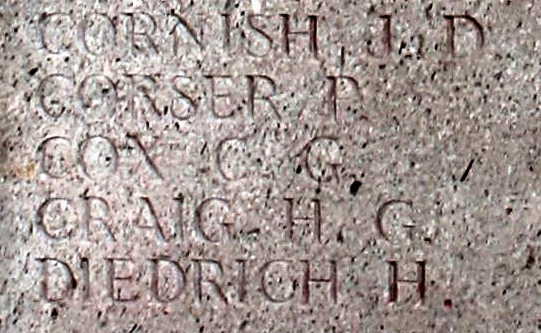
Cemetery or Memorial Details Lone Pine Memorial, Gallipoli Peninsula, Canakkale Province, Turkey
Source AWM145 Roll of Honour cards, 1914-1918 War, Army
Your content goes here. Edit or remove this text inline or in the module Content settings. You can also style every aspect of this content in the module Design settings and even apply custom CSS to this text in the module Advanced settings.
Harold Percival Diedrich: Remembered with Honor
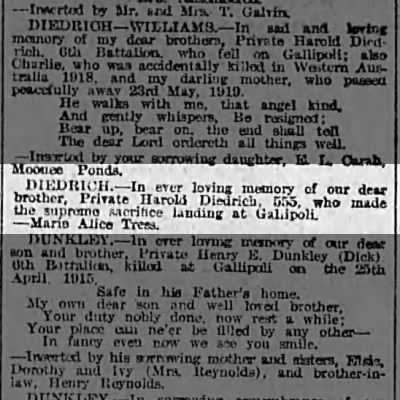
Harold Percival Diedrich was born in June 1895 in Marrickville, New South Wales, to Charles Frederick William Amandus Diedrich and Emily Jessie Andrew. He grew up in a large family, surrounded by five brothers and five sisters.
In August 1914, at the age of 19, Harold enlisted in the Australian Imperial Force. He joined the 6th Battalion, E Company, and embarked from Melbourne, Victoria, on board Transport A20 Hororata on October 19, 1914, bound for Egypt. Harold served his country with courage and dedication during World War I.
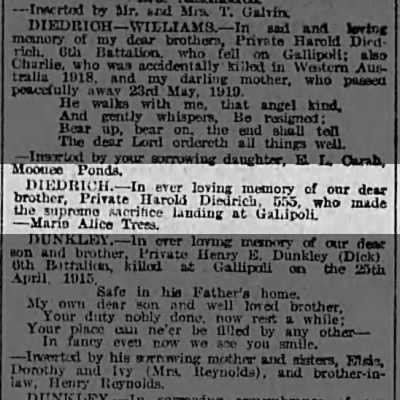
Tragically, Harold lost his life on April 25, 1915, during the Gallipoli Campaign. He was just 19 years old. He was buried in Gelibolu, Canakkale, Turkey, and his name is commemorated on the Lone Pine Memorial, honoring the Australians and New Zealanders who have no known grave.
Harold's sacrifice is remembered with honor, and his name is inscribed alongside thousands of others who gave their lives in service to their country. He is commemorated on the Roll of Honour at the Australian War Memorial, a lasting tribute to his bravery and sacrifice.
Though Harold's life was cut short, his memory lives on in the hearts of those who honor his legacy of courage and selflessness.
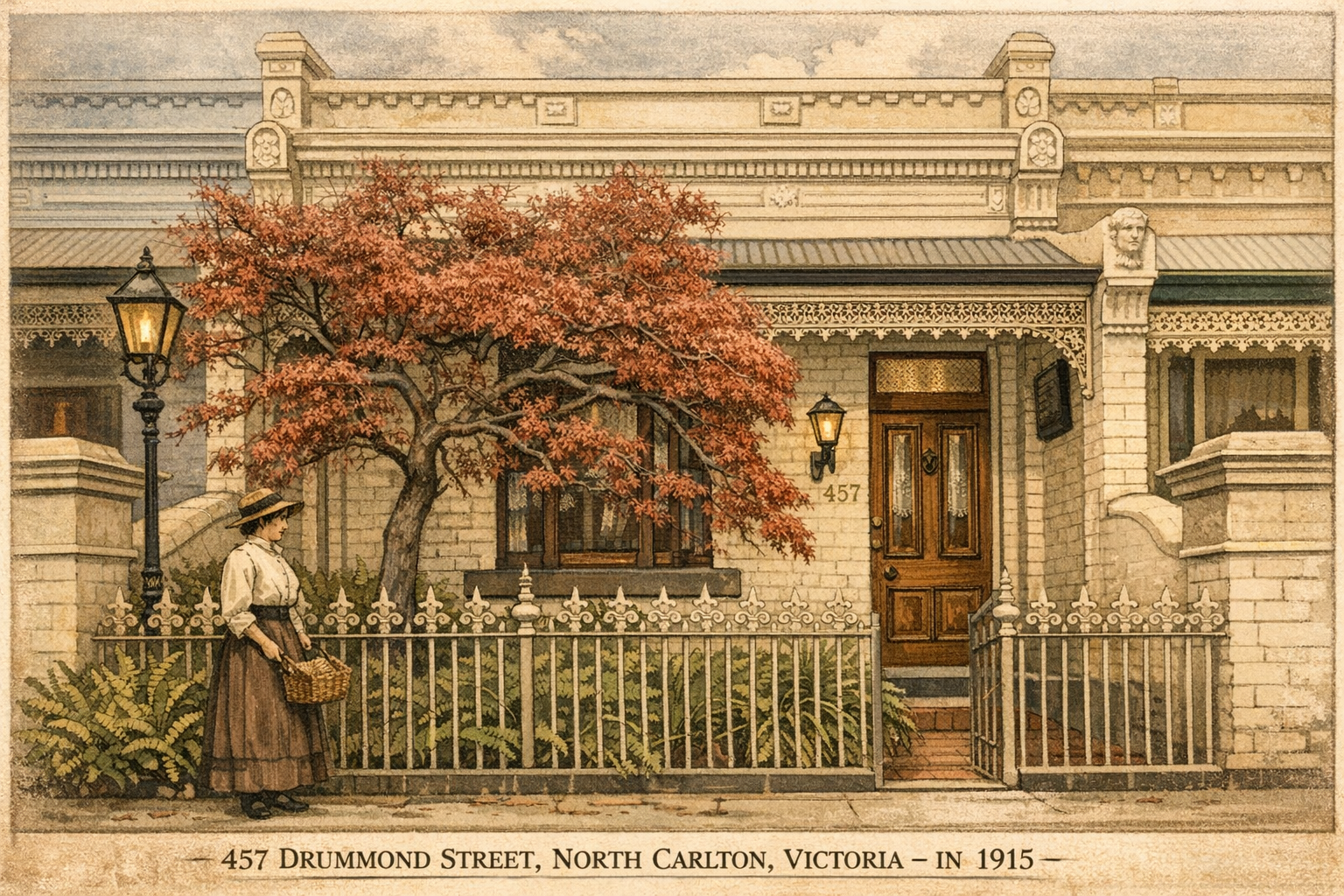
| 457 Drummond Street, North Carlton, Victoria |
BIRTH
Drummond Street in Carlton North is part of a distinctive Victorian and early 20th-century terrace and cottage streetscape, developed intensely from the 1870s through about 1915. The suburb was virtually complete development-wise by around 1915, with mostly Victorian and Edwardian housing — terraces, cottages and small villas — lining its grid.
The surrounding area has heritage overlays (planning controls to conserve historically significant buildings and streetscapes), indicating that many properties (particularly 19th- and early 20th-century residences) contribute to the historical character of North Carlton.
Typical housing at 457 during the early 1900s would have been Victorian or Edwardian terrace or cottage style, similar to neighbours built in late 1800s and early 1900s — single-storey terraces or semi-detached homes with rendered facades, decorative ironwork, verandahs and modest front gardens.
📜 Historical Mentions
I found a couple of historical snippets referencing 457 Drummond St in early 20th-century documents, which suggest the address was in use at that time:
1913 advertisement in The Age mentions “457 Drummond, Carlton” as a property with a comfortable brick house (about 4 rooms), described in real estate terms in that era.
Records from The AIF Project and related sources list 457 Drummond Street as the residence of individuals enlisting in WWI (e.g., a private from North Carlton with that address), reinforcing that the property was inhabited in the 1910s.
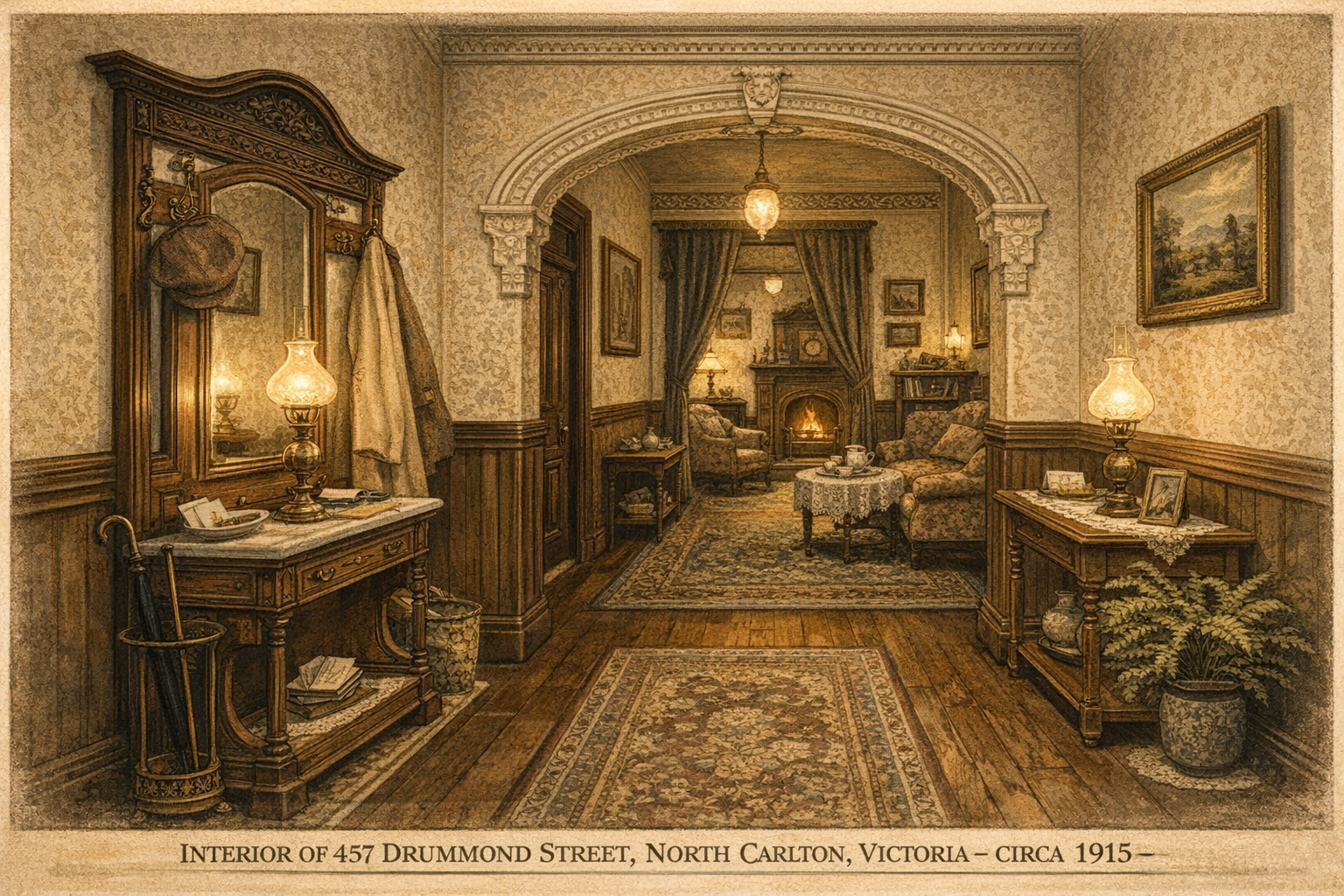
📍 What the House Probably Was Like
Based on typical housing of the period and location:
A Victorian/Edwardian era terrace or cottage with ornate cast-iron lacework, timber sash windows and a simple decorative parapet or verandah.
Small front garden with low fence, possibly decorative picket or iron.
Built for working and middle-class residents common in inner-Melbourne suburbs of the time.
It would have predated cars, with likely horse-drawn transport and early tram services nearby.
📌 What We Don’t Know for Sure
There aren’t separately published heritage citations or detailed architectural histories publicly available (or easily searchable online) that single out 457 Drummond Street as an individually listed historic building or note its architect, date of construction or unique historical events.
🏛️ In Summary
While there’s no standalone historic plaque or published architectural report I could find specifically for 457 Drummond St:
It existed by at least the 1910s and was a residential address in North Carlton.
It sat in a heritage precinct of Victorian/Edwardian housing common to the area.
It very likely would have been a Victorian-era terrace or cottage fitting the streetscape pattern in 1915.
If you want more detailed heritage or title history (owner names, dates of construction, architectural plans), those are usually found in local council archives or state heritage property files, which may require a council or state library search request.
Your content goes here. Edit or remove this text inline or in the module Content settings. You can also style every aspect of this content in the module Design settings and even apply custom CSS to this text in the module Advanced settings.
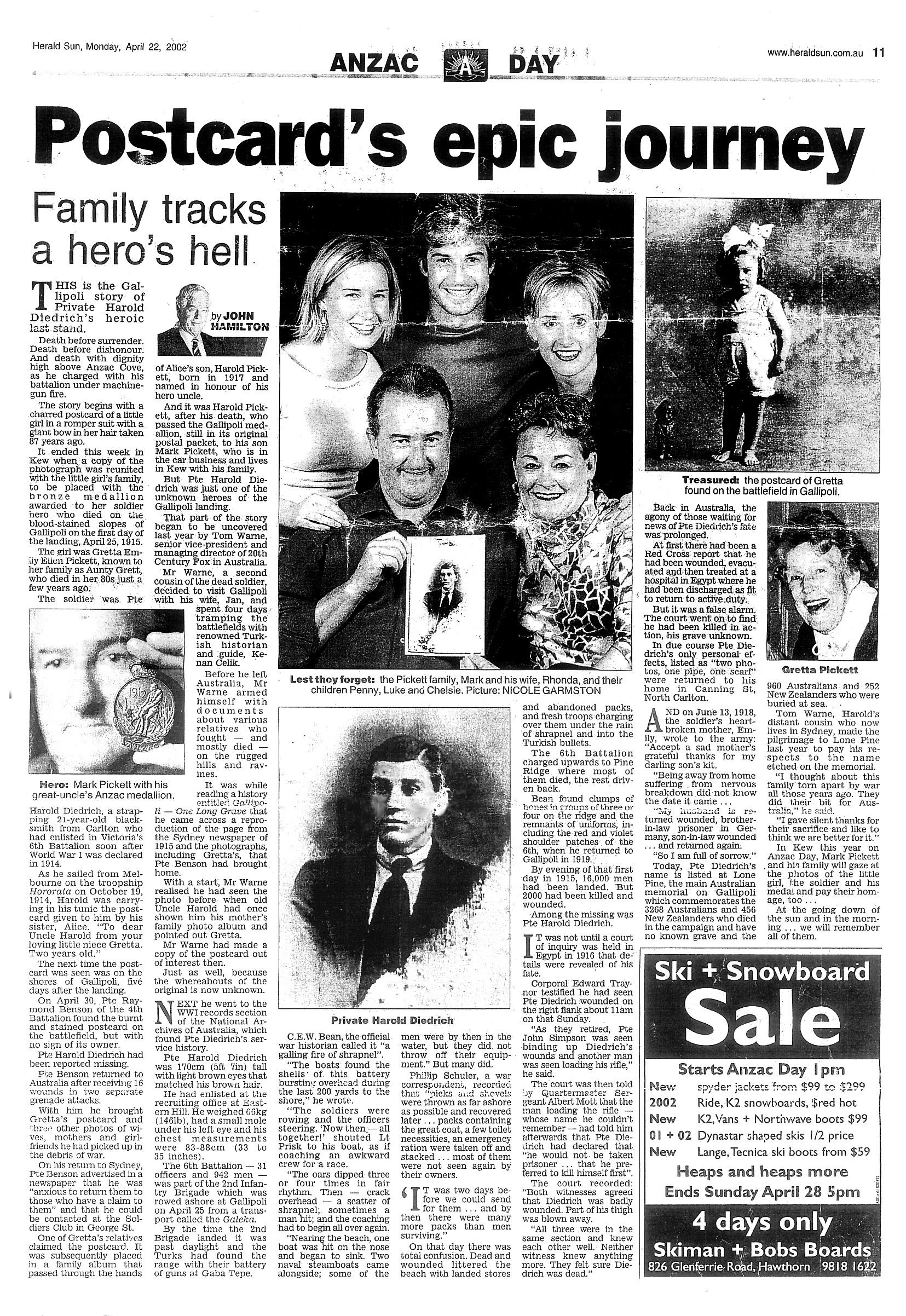
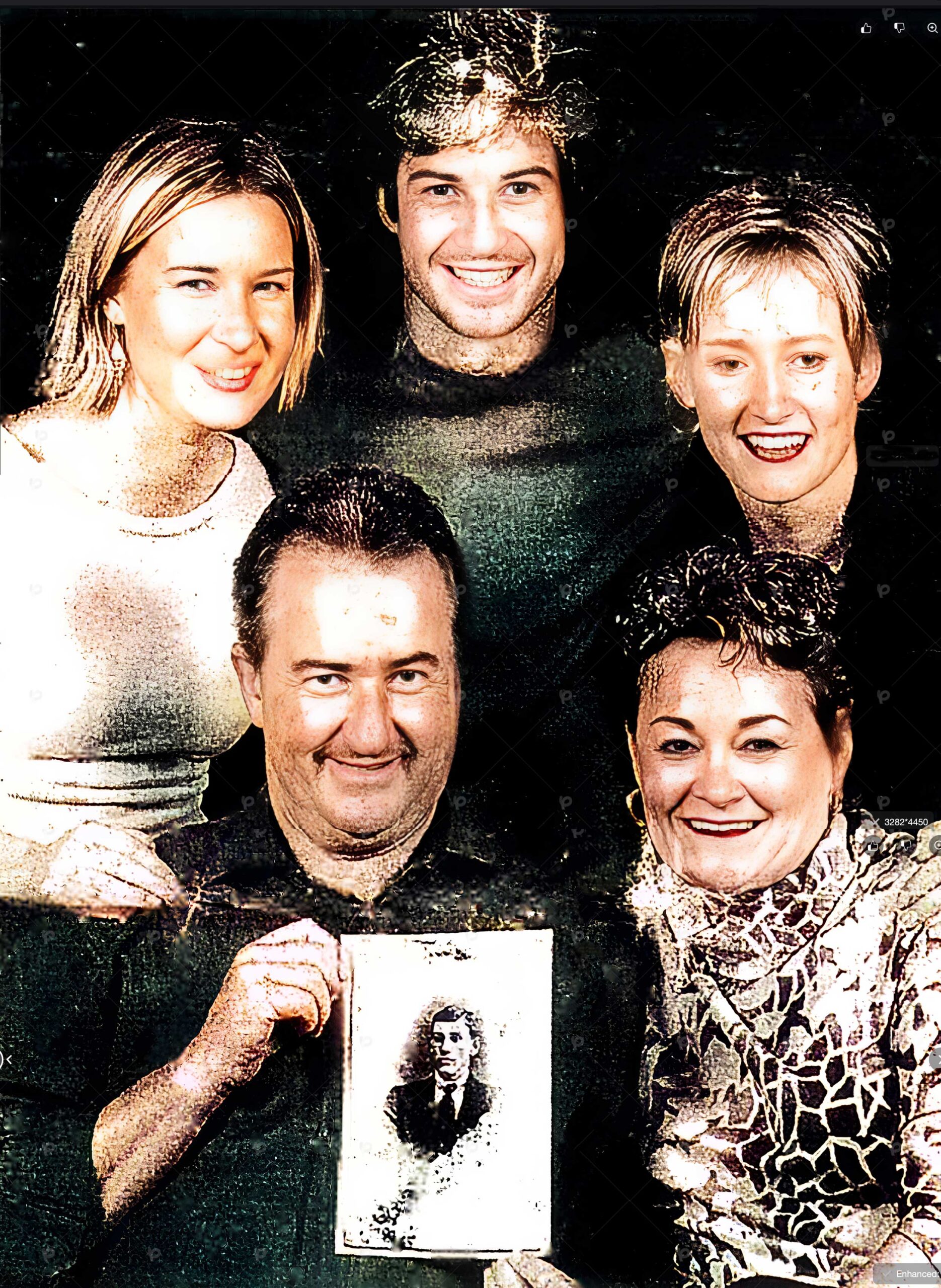
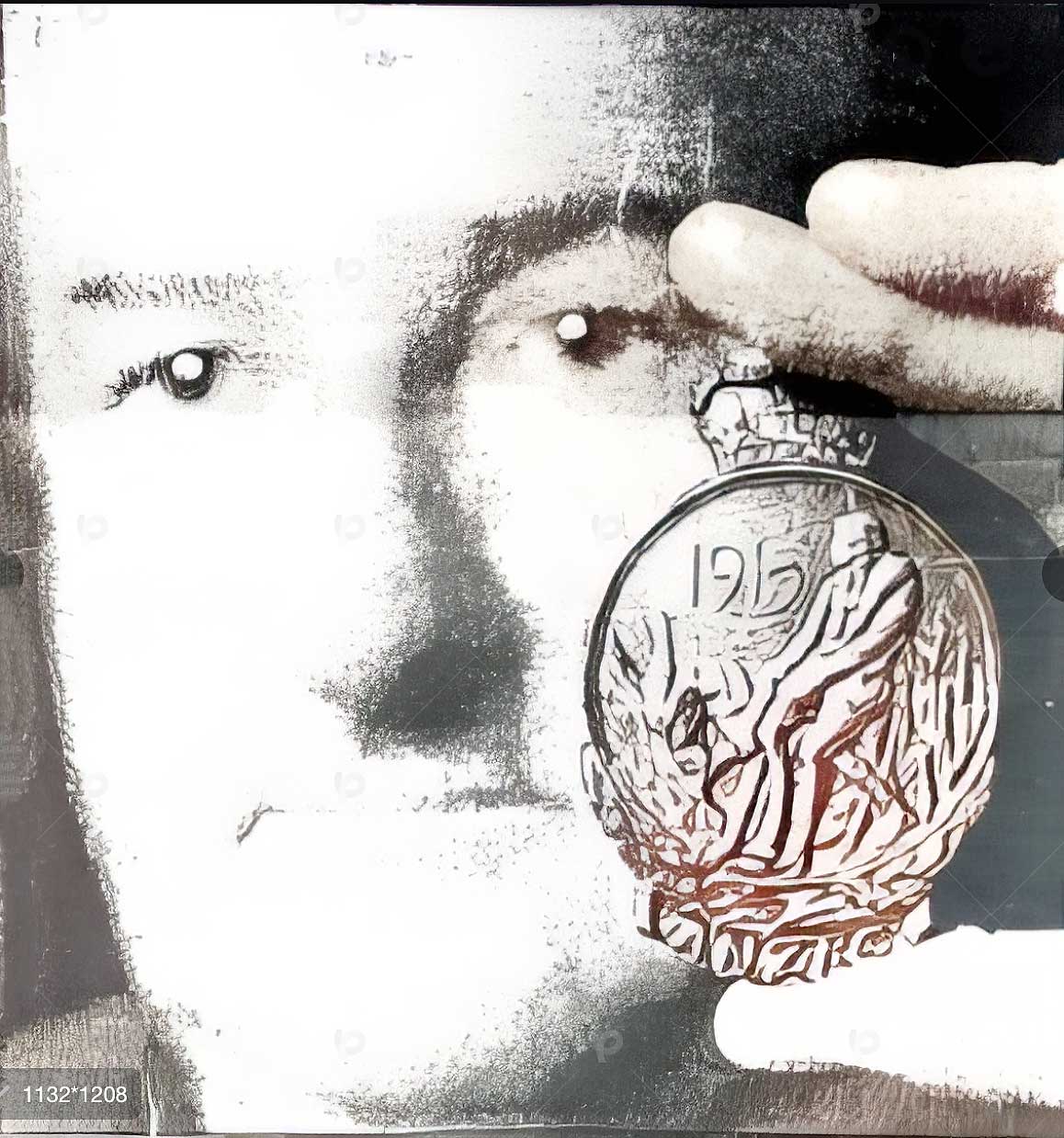
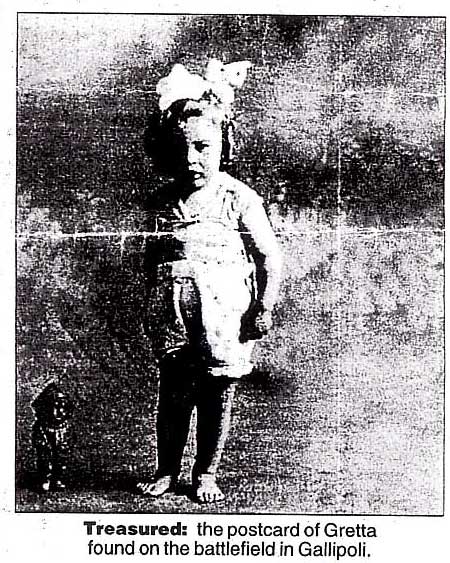
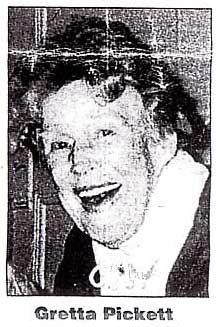
THIS is the Gal-lipoli story of Private Harold Diedrich's heroic last stand. Death before surrender. Death before dishonour. And death with dignity high above Anzac Cove, as he charged with his battalion under machine-gun fire. The story begins with a charred postcard of a little girl in a romper suit with a giant bow in her hair taken 87 years ago. It ended this week in Kew when a copy of the photograph was reunited with the little girl's family, to be placed with the bronze medallion awarded to her soldier hero who died on the blood-stained slopes of Gallipoli on the first day of the landing, April 25, 1915. The girl was Gretta Em-ily Euen Pickett, known to her family as Aunty Grett, who died in her 80s just a few years ago. .
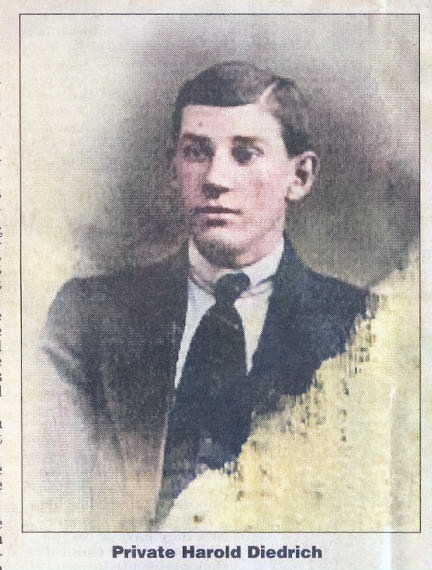
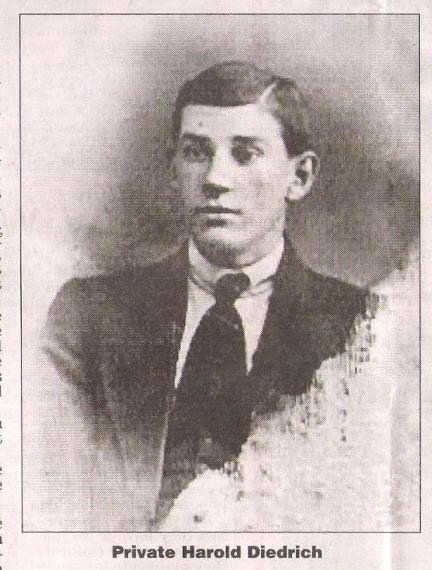
The soldier was Harold Diedrich, a strapping 21-year-old black-smith from Carlton who had enlisted in Victoria's 6th Battalion soon after World War I was declared in 1914. As he sailed from Mel-bourne on the troopship Hororata on October 19, 1914, Harold was carry-ing in his tunic the post-card given to him by his sister, Alice. "To dear Uncle Harold from your loving little niece Gretta. Two years old." The next time the post-card was seen was on the shores of Gallipoli, five days after.the landing. On April 30, Pte Ray-mond Benson of the 4th Battalion found the burnt and stained postcard on the battlefield, but with no sign of its owner. Pte Harold Diedrich had been reported missing. Pie Benson returned to Australia after receiving 16 wounds in two seperate grenade attacks. With him he brought Gretta's postcard and thr, other photos of wi-ves, mothers and girl-friends he had picked up in the debris of war. On his return to Sydney, Pte Benson advertised in a newspaper that he was "anxious to return them to those who have a claim to them" and that he could be contacted at the Sol-diers Club in George St. One of Gretta's relatives claimed the postcard. It was subsequently placed in a family album that passed through the hands
of Alice's son, Harold Pick-ett; born in 1917 and named in honour of his hero uncle. And it was Harold Pick-ett, after his death, who passed the Gallipoli med-. alhon, still in its original pogtal packet, to his son Mark Pickett, who is in • the car business and lives in Kew.with his family. But Pte Harold Die-drich was just one of the unknown heroes of the Gallipoli landing. That .part of the story began to be uncovered last year by Tom Warne, senior vice-president and managing director. of 20th Century Fox in Australia. Mr Warne, a . second. cousin•of the dead soldier, .dOeided to visit Gallipoli with his wife, Jan, and spent. four da,ys.• 'tramping the battlefields with renowned Turk-ish historian and :guide, • Ke-nan Celik. Before he left Australia, Mr Warne armed himself with documents about various relatives who fought — and mostly died —on the rugged hills and rav-ines. th his It was while reading a history entitled Gallipo-li — One Long Grave that he came across a repro-duction of the page from the Sydney newspaper of 1915 and the photographs, including .Gretta's, that. Pte .Benson had brought home. With a start; Mr Warne realised he had seen the photo before. when old Uncle Harold had once shown him his mother's family photo album and pointed out Gretta. Mr Warne had made a copy of the postcard out of interest then. Just as well, because the whereabouts of the original is now unknown. NEXT he went to the WWI records section of the National Ar-chives of Australia, which found Pte Diedrich's ser-vice history. Pte Harold Diedrich was 170cm (5ft Tin) tall with light brown eyes that matched his brown hair. He had enlisted at the recruiting office at. East-ern Hill. He weighed 66kg (1461b), had a small mole under his left eye and his chest measurements were 83-88em (33 to 35 inches). The 6th Battalion — 31 officers and 942 men —was part of the 2nd Infan-try Brigade which was rowed ashore at Gallipoli on April 25 from a trans-port called the Galeka. By the time the 2nd Brigade landed it was past daylight and the Turks had found the range with their battery of guns at Gabe Tepe.
C.E.W. Bean, the official war historian called it "a galling fire of shrapnel". "The boats found the shells of this battery bursting overhead during the last 200 yards to the shore," he wrote. "The soldiers were rowing and the officers steering. 'Now then — all together!' shouted Lt Prisk to his boat, as if coaching an awkward crew for a race. "The oars dipped three or four times in fair rhythm. Then — crack overhead — a scatter of shrapnel; sometimes a man hit; and the coaching had to begin all over again. "Nearing the beach, one boat was hit on the nose and began to sink. Two naval steamboats came alongside; some of the men were by then in the water, but they did not throw off their equip-ment."
But many did. Phillip Schuler, a war correspondent, recorded that "picks and shovels were thrown as far ashore as possible and recovered later ... packs containing the great coat, a few toilet necessities, an emergency ration were taken off and stacked ... most of them were not seen again by their owners.
IT was two days be-fore we could send for them ... and by then there were many more packs than men surviving." On that day there was total confusion. Dead and wounded littered the beach with landed stores
and abandoned packs, and fresh troops charging over them under the rain of shrapnel and into the Turkish bullets. The 6th Battalion charged upwards to Pine Ridge where most of them died, the rest driv-en back. Bean found clumps of bones in groups of three or four on the ridge and the remnants of uniforms, in-cluding the red and violet shoulder patches of the Gth, when he returned to Gallipoli in 1919. By evening of that first day in 1915, 16,000 men had been landed. But 2000 had been killed and wounded. Among the missing was Pte Harold Diedrich. IT was not until a court of inquiry was held in Egypt in 1916 that de-tails were revealed of his fate. Corporal Edward Tray-nor testified he had seen Pte Diedrich wounded on the right flank about 11 am on that Sunday. "As they retired, Pte John Simpson was seen binding up Diedrich's wounds and another man was seen loading his rifle," he said. The court was then told by Quartermaster Ser-geant Albert Mott that the man loading the rifle —whose name he couldn't remember — had told him afterwards that Pte Die-drich had declared that "he would not be taken prisoner ... that he pre-ferred to kill himself first". The court recorded: "Both witnesses agreed that Diedrich was badly wounded. Part of his thigh was blown away. "All three were in the same section and knew each other well. Neither witness knew anything more.
They felt sure Diedrich was dead."
Back •in Australia, the agony of those waiting for news of Pte Diedrich's fate was prolonged.. - At firsf there had been a Red Croie: report that lie had been ,,viounded,.evacu, ated andfthen treated at a hcispitalinEgyptwhere he . been .clischaigectas ..fit • • '• to return•to•activeidutY, But it•was a: false. alarin.• •The dourt!.vienton:to And, • he had been ldlled in: ac, tion, his grave•unknown. Tn due course Pte Die-drich's only personal ef-fects, listed as "two pho-tos, Olio' pipe, one scarf" • were returned . to his home •in' Canning St, North Carlton. AND on Able 13,1918, the soldier's heart-broken. mother, Em-ily, wrote to the army: "Accept. a sad mother's grateful thanks for my darling son's kit. "Being away from home suffering... from nervous breakdown did • not know the date it wine . , "Zyiy • 1,..,aband is re-turned wounded; brother-in-law prisoner in ina.ny, son-in-law wounded „ and returnedagah, "So I am full' Of sorrow:" Today, . Pte Diedrieh's name is listed . at Lone Pine, the main Australian memorial' on 'Gallipoli which commemorates the 3268 Australians and 45'6 New Zealanders who died in the campaign and have no known grave and the •ArCIlltel 960 Australians and 252 New Zealanders who were buried at sea. Tom Warne, Harold's distant cousin who now lives in. Sydney, made the pilgrimage to Lone Pine last year. to pay his re-spects to the name etched• on the memorial. "I thought about this family • torn apart by war all those years ago. They did their . bit for Aus-tralia," he said. "I gave silent thanks for their sacrifice .and like to think we are better for it." In Kew this year on Anzac Day, Mark Pickett . and his family will gaze at the photos of the little girl, the soldier and his medal and' pay their hom-age, too At the going down of the sun and in the morn-ing ... we will remember all of them.
Your content goes here. Edit or remove this text inline or in the module Content settings. You can also style every aspect of this content in the module Design settings and even apply custom CSS to this text in the module Advanced settings.
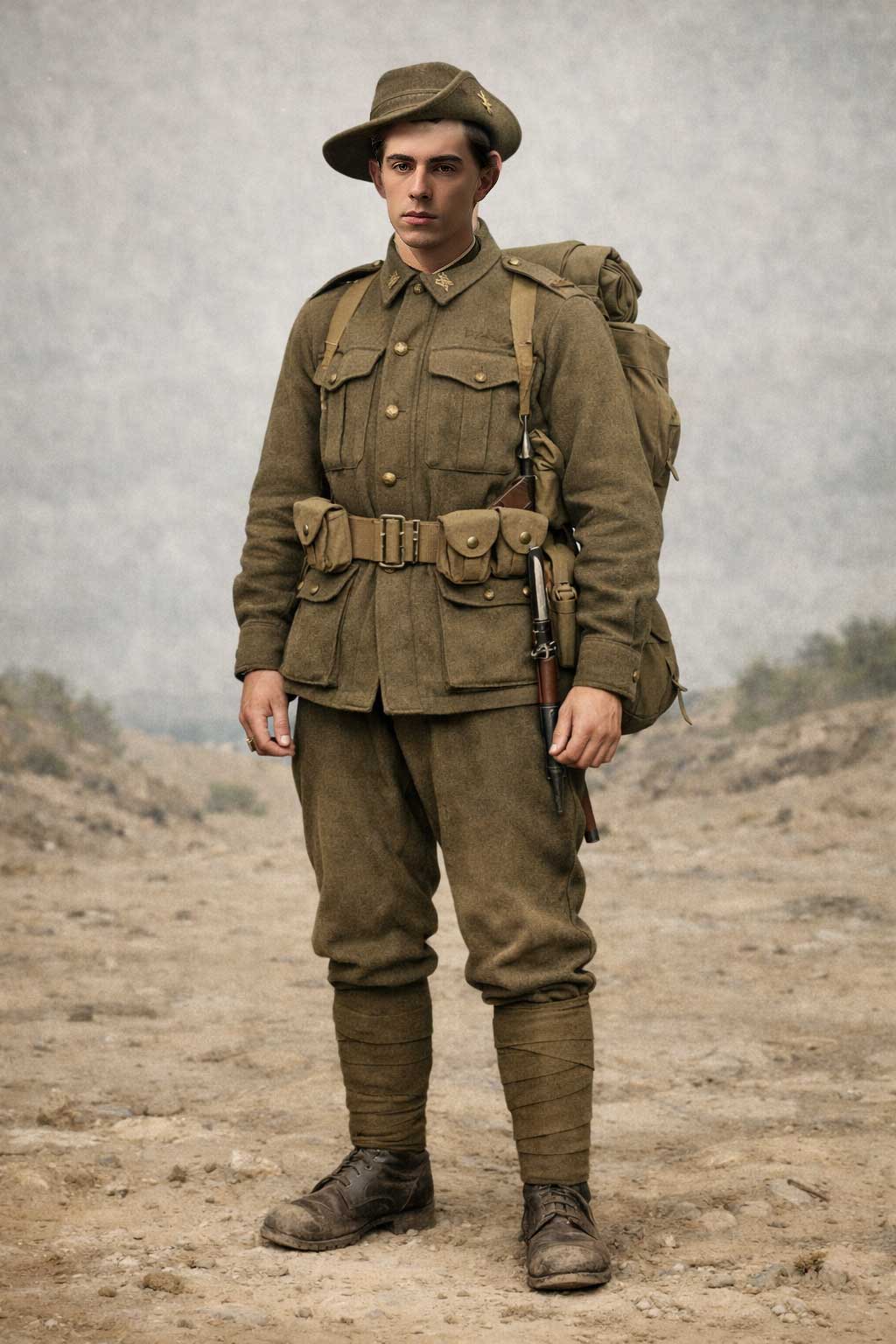
Military Service
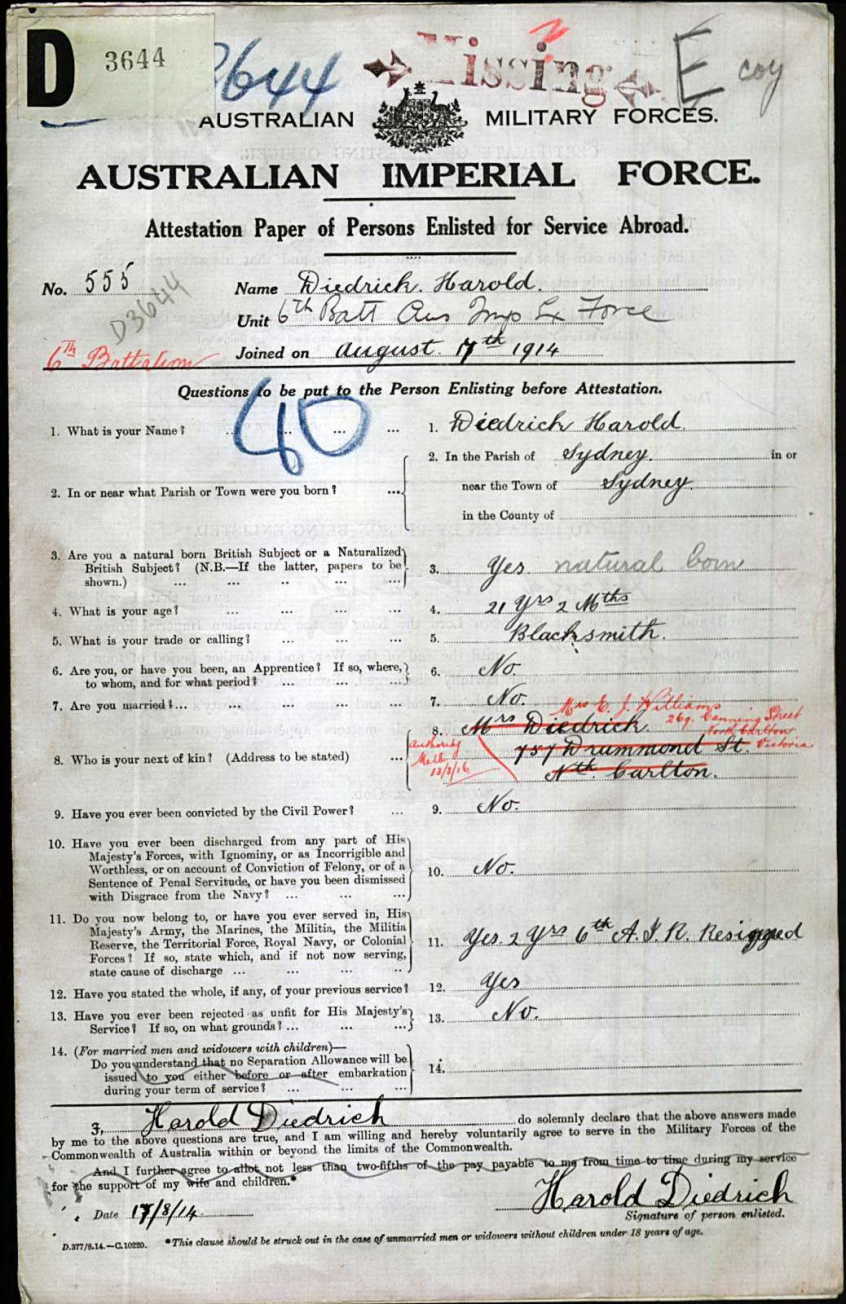
**http://naa12.naa.gov.au/scripts/imagine.asp?B=3506735&I=1&SE=1**
Joined the Australian Imperial Force
Regimental number: 555
Enlistment date:17 August 1914 (21yrs 2mths)
Rank on enlistment:Private
Unit name: 6th Battalion, E Company AWM Embarkation
Roll number: 23/23/1
Embarkation details: Unit embarked from Melbourne, Victoria, on board Transport A20 Hororata on 19 October 1914
Service number 555
Rank Private
Unit 6th Australian Infantry Battalion
Service Australian Imperial Force
Conflict/Operation First World War, 1914-1918
Conflict Eligibility Date First World War, 1914-1921
Cause of Death Killed in action
Place of Association North Carlton, Melbourne, Victoria, Australia
Cemetery or Memorial Details Lone Pine Memorial, Gallipoli Peninsula, Canakkale Province, Turkey
Source AWM145 Roll of Honour cards, 1914-1918 War, Army
Rank from Nominal Roll: Private
Unit from Nominal Roll: 6th Battalion
Fate: Killed in Action 25 April 1915 Gallipoli
Commemoration details: The Lone Pine Memorial (Panel 26), Gallipoli, Turkey The Lone Pine Memorial, situated in the Lone Pine Cemetery at Anzac, is the main Australian Memorial on Gallipoli, and one of four memorials to men of the New Zealand Expeditionary Force.
Designed by Sir John Burnet, the principal architect of the Gallipoli cemeteries, it is a thick tapering pylon 14.3 metres high on a square base 12.98 metres wide. It is constructed from limestone mined at Ilgardere in Turkey.
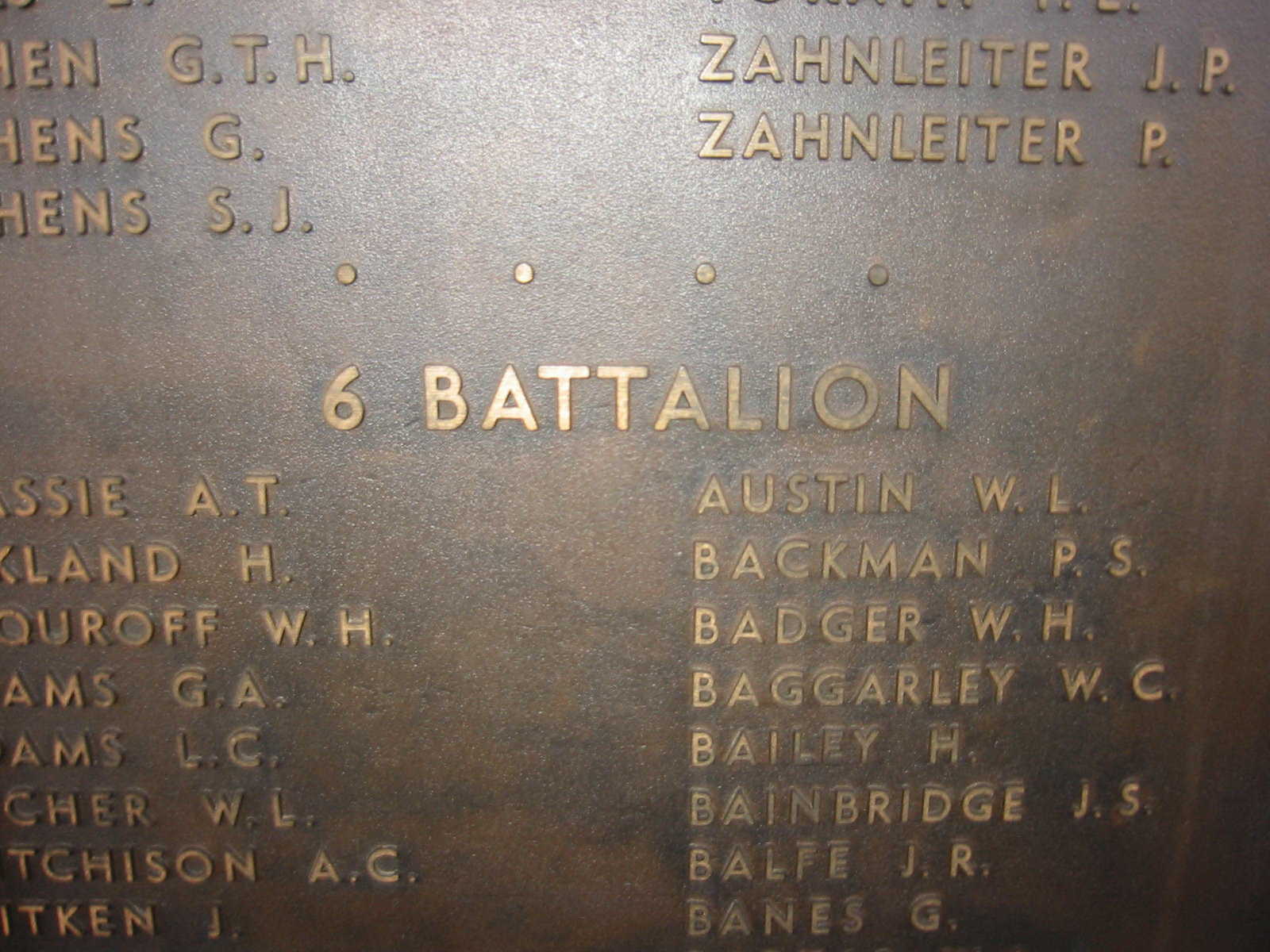
The Memorial commemorates the 3268 Australians and 456 New Zealanders who have no known grave and the 960 Australians and 252 New Zealanders who were buried at sea after evacuation through wounds or disease. The names of New Zealanders commemorated are inscribed on stone panels mounted on the south and north sides of the pylon, while those of the Australians are listed on a long wall of panels in front of the pylon and to either side. Names are arranged by unit and rank.
The Memorial stands over the centre of the Turkish trenches and tunnels which were the scene of heavy fighting during the August offensive. Most cemeteries on Gallipoli contain relatively few marked graves, and the majority of Australians killed on Gallipoli are commemorated here. Panel number, Roll of Honour, Australian War Memorial46
Other details
War service: Egypt, Gallipoli Medals: 1914-15 Star, British War Medal, Victory Medal
Personal Details
Height: 5'7"
Hair Colour: Brown
Eye Colour: Light Brown
Distinctive Features:
Medical:
Bloodtype:
Serious Illnesses/Medical Conditions:
Notes:
Links to Australian War Memorial Records
Roll of Honour
http://www.awm.gov.au/research/people/roll_of_honour/person.asp?p=572393
Red Cross Wounded and Missing Records
http://www.awm.gov.au/research/people/wounded_and_missing/person.asp?p=604744
Your content goes here. Edit or remove this text inline or in the module Content settings. You can also style every aspect of this content in the module Design settings and even apply custom CSS to this text in the module Advanced settings.
Your content goes here. Edit or remove this text inline or in the module Content settings. You can also style every aspect of this content in the module Design settings and even apply custom CSS to this text in the module Advanced settings.
f6f4d636-e215-46a8-aba4-d498f819d529
5fc42f53-72bb-4994-bfbb-c657c274a2ef
4c1ab5bd-749e-4fcd-9876-54990478bed1
04a04bb5-69b9-4e8f-bec2-4df484c85a03
6db09035-c8df-45f6-9836-a18f95c97986
adfd6d1c-2bf5-47b2-a72b-b6295a2df992
Birth
When Harold Percival Diedrich was born in June 1895 in Marrickville, New South Wales, his father, Charles, was 46 and his mother, Emily, was 37. He had five brothers and six sisters. He died on 25 April 1915 in Gelibolu, Canakkale, Turkey, at the age of 19, and was buried there.
15 Nov
1897
Age 2
Death of Father
His father Charles Frederick William Amandus passed away on 15 November 1897 in Victoria at the age of 48.

Male
Charles Frederick William Amandus Diedrich
1849–1897
15 Nov 1897 • Carlton, Victoria, Australia